

Great music charts do more than rank popular songs. They capture moments, moods, communities, and cultural sparks that arrive from unexpected places. That is exactly what makes a football anthem so interesting. Sometimes a song tied to sport is not just a soundtrack for a tournament or a catchy chant for a crowd. It becomes part of a larger story about identity, atmosphere, and the way songs travel through public life.
The release of Copamore and the Saturday Game, linked with the playful and mysterious tagline about a Saturday that never ended somewhere near Saturn, points to a very specific creative idea. This is not presented like a polished corporate tournament theme. It feels imaginative, slightly surreal, rooted in football culture, and intentionally designed to stand apart from predictable sports music. That difference matters, especially when discussing music charts, because songs that stand out emotionally and visually often gain traction in ways no one expects.
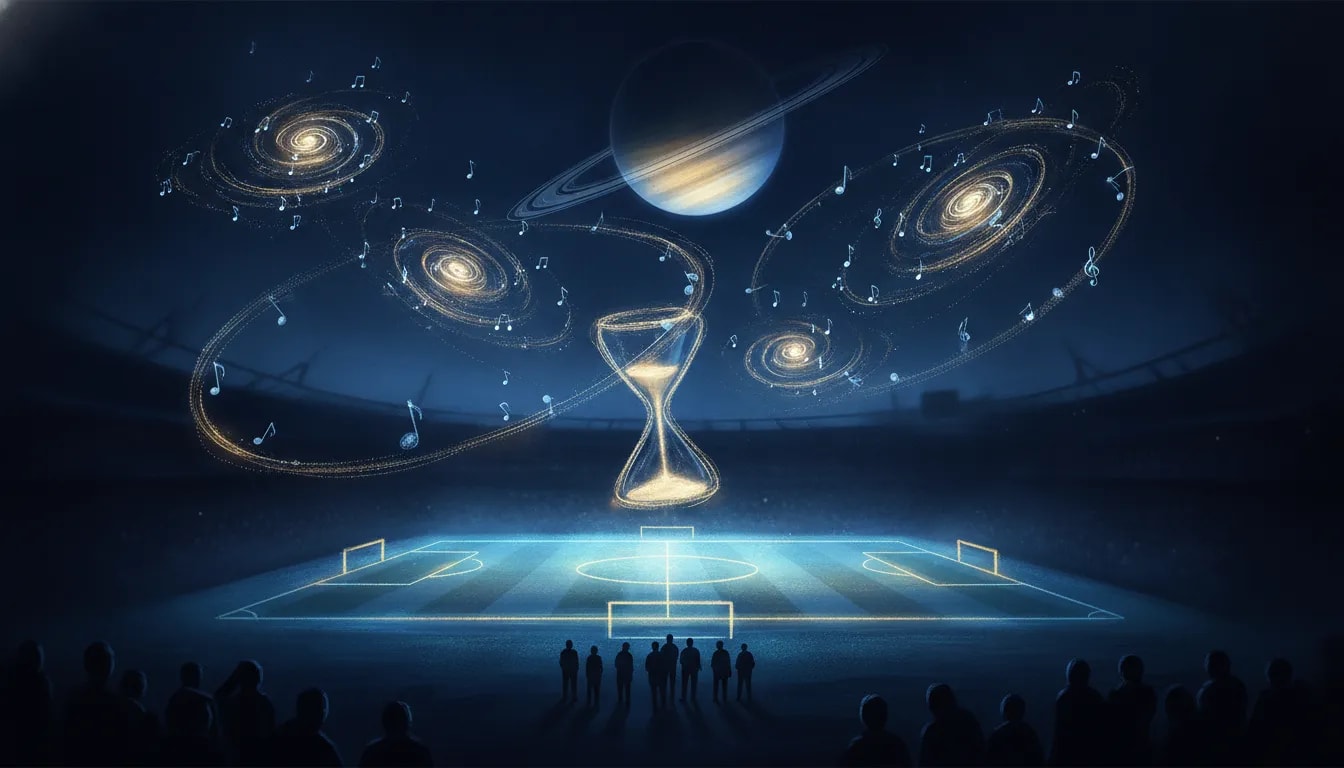
Even from the artwork alone, there is a clear message. Football is being framed as a lived, almost cinematic experience. Floodlights glow over a crowded stadium. A player in a number 22 shirt stands with the ball. A scoreboard shows a match in progress. Above it all, the sky turns cosmic. That combination of street-level passion and dreamlike imagery gives the project an identity that can cut through the noise of ordinary releases.
When people talk about music charts, they often focus on raw numbers. Streams, downloads, social shares, playlist adds, and platform rankings all matter. But songs also rise because they create a world. This football anthem appears to do exactly that.
Table of Contents
- ⚽ Why Football Anthems Still Matter
- 🎵 What Makes an Unexpected Anthem Work
- 🌌 The Role of Visual World-Building in Music Charts
- 📈 How Niche Songs Find a Place in Music Charts
- 🏟️ Football Culture Is Bigger Than the Match
- 🚀 Why the “Near Saturn” Idea Actually Works
- 🔊 What Repetition Can Do for a Football Anthem
- 💡 Lessons for Artists Trying to Break Into Music Charts
- 🌍 Where This Fits in the Broader Musiccharts24 Approach
- 🧠 The Real Reason Unexpected Songs Break Through
- ❓FAQ
⚽ Why Football Anthems Still Matter
Football anthems occupy a unique place in popular music. They sit between mainstream songs, national pride, fan culture, event marketing, and collective memory. A standard pop release may succeed because it is catchy or well promoted. A football anthem has another job. It needs to feel communal. It should sound like it belongs in public spaces, in celebration, in anticipation, and in the emotional swings of a match day.
That is why football songs can influence music charts in unusual ways. Their momentum is not always linear. A track may stay quiet at first and then suddenly surge when a competition, meme, highlight reel, or fan ritual gives it new life. This kind of song often depends on context as much as composition.
The phrase associated with the track, suggesting that things somehow keep circling around, hints at repetition and return. That fits football culture well. Matches repeat weekly. Chants repeat across generations. Tournament songs resurface every season. In the world of music charts, repetition is powerful because replayability is one of the clearest signs that a song has staying power.
🎵 What Makes an Unexpected Anthem Work
The most memorable sports songs are not always the most obvious ones. Sometimes the strongest anthem is the one that avoids sounding manufactured. An unexpected anthem works when it combines a few elements well:
- A distinct atmosphere that listeners can recognize instantly
- A strong visual identity that reinforces the music
- A sense of place connected to football culture rather than generic hype
- Repeatable phrasing or melodic movement that feels easy to return to
- Emotional openness that lets fans attach their own meaning to the song
This project leans heavily into atmosphere. The references to fading floodlights, endless Saturday energy, and a surreal outer-space setting suggest that the song is trying to evoke more than victory. It is interested in football as mood, ritual, and myth.
That kind of positioning can help a song on music charts because it gives it multiple entry points. Some people may connect with it as football music. Others may respond to the storytelling, the aesthetic, or the novelty of a sports track that feels more like a piece of world-building than an advertising jingle.
🌌 The Role of Visual World-Building in Music Charts
Artwork and visual branding are often treated as secondary details, but they can shape how a song performs. In crowded digital environments, listeners make quick judgments. Cover art, clip thumbnails, and short visual loops frequently determine whether someone gives a song a chance. That means visual language can affect music charts indirectly but significantly.
The imagery attached to this anthem is especially notable. It presents football not simply as a sport, but as a night-time spectacle suspended between reality and fantasy. The stadium appears alive. The crowd is present. The scoreboard matters. Yet the sky introduces something larger and strange, almost cosmic. The result is memorable because it refuses to look generic.
For a song aiming to break into music charts, memorability matters just as much as accessibility. A distinctive visual package helps a release stand out across social posts, streaming platforms, and editorial pages. It also invites interpretation, and songs that generate interpretation tend to remain in circulation longer.
📈 How Niche Songs Find a Place in Music Charts
There is a common assumption that only broad, radio-friendly tracks can climb music charts. In reality, niche songs can perform surprisingly well when they connect deeply with a defined audience first. Football culture is one of the clearest examples of this dynamic. It is global, emotionally intense, and highly social.
A football anthem can begin in a niche and still travel far because football itself crosses borders. Fans share clips, playlists, chants, and themed tracks quickly. Once a song becomes associated with a feeling or moment, it may move beyond its original audience.
Songs tied to sport often benefit from three stages of growth:
- Identity formation, when the song establishes its own character.
- Community adoption, when fans begin connecting it with a shared mood or ritual.
- Chart visibility, when data begins reflecting that cultural momentum.
This model helps explain why an “unexpected” anthem can matter. It may not start with broad commercial expectations, but if it nails identity and community resonance, the music charts can eventually catch up.
🏟️ Football Culture Is Bigger Than the Match
One of the most useful insights from this release is that football culture extends well beyond ninety minutes of play. It includes anticipation, travel, local pride, late-night discussion, neighborhood memory, and the emotional residue of games that linger long after the final whistle.
The creative cues around this anthem suggest that it understands football as atmosphere. The title itself ties the song to Saturday, which is not just a day of the week in many football traditions. It is a recurring cultural event. It carries routine, expectation, and a sense of belonging. A song that taps into that can have a stronger emotional shelf life than one focused only on a tournament slogan.
That is highly relevant to music charts. Songs with recurring use cases often last longer. A football anthem attached to one tournament may spike and vanish. A football anthem attached to the broader weekly feeling of the game can keep returning, especially if supporters see it as part of their own soundtrack.
🚀 Why the “Near Saturn” Idea Actually Works
On paper, combining football with cosmic imagery might seem unusual. In practice, it can be a smart creative move. Sport already invites exaggeration. Fans describe dramatic matches as unreal, legendary, or otherworldly. Great anthems amplify that sensation.
The line about a Saturday that never ended somewhere near Saturn creates a dream-state. It turns a football occasion into something timeless and slightly off the map. That helps the song avoid cliché. Instead of sounding like every other motivational sports release, it builds a universe.
In the context of music charts, unusual imagery can support discoverability in a softer but important way. Distinctive ideas are easier to remember, easier to describe, and easier to share. If someone can say, “This is that football anthem with the cosmic Saturday vibe,” the song immediately has a hook beyond its title alone.
🔊 What Repetition Can Do for a Football Anthem
The tiny lyrical fragment available from the song points toward circular movement, something returning and revolving. That is a small clue, but it matters. Repetition is central to all anthemic music. Chants repeat. Choruses loop. Hooks become stronger through familiarity.
For football songs, repetition serves two purposes:
- It makes the track easier to remember.
- It increases the chance that people adopt it collectively.
This is where music charts and human behavior meet. Repeated listening is not just a metric. It is often the clearest sign that a song fits naturally into real habits. Tracks that can live in gatherings, sports contexts, highlight edits, and personal playlists often build stronger chart trajectories over time.
💡 Lessons for Artists Trying to Break Into Music Charts
Even with limited information, this release offers several useful lessons for artists, producers, and marketers who want to create songs that can stand out in music charts.
Build a clear identity
Songs are easier to support when they feel complete. Title, artwork, mood, and concept should reinforce each other. A football anthem needs more than energy. It needs personality.
Choose culture over formula
Generic hype music is forgettable. Tracks rooted in actual football culture, whether through imagery, pacing, emotion, or storytelling, are more likely to earn lasting attachment.
Give the song a world
World-building helps people remember and describe a release. This anthem uses stadium lights, a player figure, a scoreboard, urban night energy, and cosmic references to create a distinct setting.
Leave room for interpretation
Not every element has to be literal. Ambiguity can help a song travel because different communities can project different meanings onto it.
Think beyond the first spike
Songs built around recurring rituals may have longer lives than songs built around one media moment. That long tail can be just as important on music charts as the opening week.
🌍 Where This Fits in the Broader Musiccharts24 Approach
The branding around the release clearly places it within a football-focused music ecosystem. That matters because focused platforms can help niche songs grow with more consistency than broad, unfocused promotion. A project linked to football anthems and World Cup themed music is already speaking to a recognizable audience.
For readers interested in exploring that space further, Musiccharts24 offers a broader home for football-related music projects, while the Copamore release page connects directly to this specific anthem.
This kind of ecosystem can influence music charts in practical ways. When a release is part of a clearly defined theme or catalog, it benefits from stronger context, better discoverability among interested listeners, and more coherent storytelling across channels.
🧠 The Real Reason Unexpected Songs Break Through
Unexpected songs rarely succeed by accident alone. They break through because they occupy a space other releases ignore. In this case, the football anthem appears to sit between sport, fantasy, nostalgia, and atmosphere. That is a narrower lane than mainstream pop, but it is also less crowded.
The best opportunities in music charts often come from this kind of distinct positioning. A song does not need to appeal to everyone immediately. It needs to mean something clearly to someone first. If that connection is strong, growth can follow.
This is especially true in football culture, where emotion is already amplified. A song that captures the feeling of the floodlights, the crowd, the endless Saturday mood, and the mythology of the game can become larger than its initial release footprint.
❓FAQ
What is the main appeal of this football anthem?
Its appeal comes from mood and identity. Instead of relying only on loud, predictable sports energy, it creates a more imaginative football world with strong visual and emotional cues.
Why are football songs relevant to music charts?
Football songs often connect with highly engaged communities. That can lead to repeat plays, social sharing, and seasonal resurgence, all of which can influence music charts.
What makes an anthem “unexpected”?
It usually means the song does not follow the obvious commercial template. It may use unusual imagery, a niche cultural angle, or a more artistic tone while still feeling memorable and communal.
Can visual branding really affect music charts?
Yes. Strong artwork and a distinctive visual concept can improve recall, sharing, and curiosity, which support discovery and replay behavior around a song.
Does a niche football track have real chart potential?
Absolutely. Niche tracks can build momentum through focused communities first. If the concept is strong and the audience connects with it, music charts can reflect that growth later.
In the end, the most interesting thing about this release is not simply that it is a football anthem. It is that it understands how atmosphere, identity, and culture can work together. That is often the hidden engine behind memorable music charts moments. Songs rise not only because they are promoted, but because they create a feeling people want to return to.
A stadium under dim floodlights, a player stepping toward the game, a score hanging in the night, and a Saturday that seems to go on forever near Saturn. That is a strong image. When a song can hold an image like that in the mind, it has already done something many releases never manage. It has become recognizable. And for music charts, recognizable is often where the story begins.
Free Music Production Class!
Check out this really cool thing
